
Follow Us



Focus on the industry trends of PP hollow board and keep abreast of the latest product information of Henan Enda!
The right PP hollow board thickness for packaging depends on the application. Lightweight dividers and layer pads may need thinner boards, while large reusable boxes and turnover containers may require thicker boards. The following guide provides practical thickness references for different packaging products.
Henan Enda New Material Co., Ltd. supplies PP hollow boards in thicknesses from 1.8 mm to 15 mm. The following guide combines Enda’s published application references with thickness ranges listed by other industry suppliers.
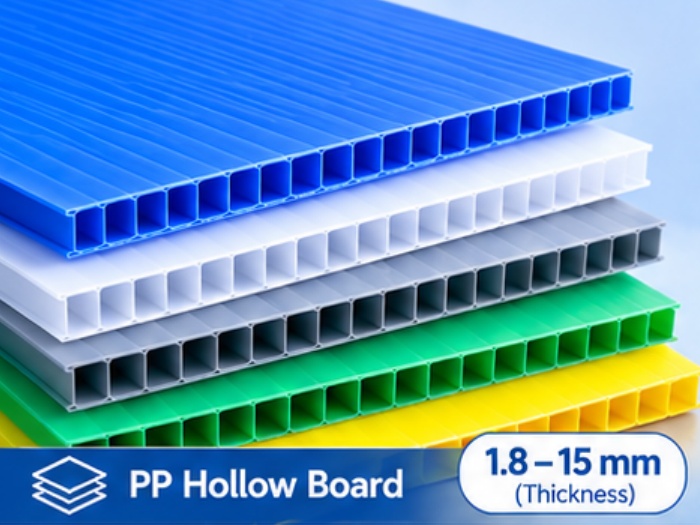 Custom thickness of pp hollow board
PP hollow board is available in different thicknesses for packaging applications. However, there is no single thickness suitable for every box, divider, or layer pad.
The table below separates Enda’s published application examples from general industry references.
| Packaging Application | Practical Thickness Reference | Data Source |
|---|---|---|
| Reusable PP hollow boxes | 3–5 mm | Industry reference |
| Warehouse clothing sorting boxes | 8 mm | Enda published example |
| General PP corrugated dividers | 2–5 mm | Industry reference |
| Heavy partitions | 4–5 mm | Enda published example |
| PP plastic layer pads | 2–4 mm; 3–5 mm for some pallet applications | Industry reference |
These are starting points, not fixed standards. The actual selection depends on board weight (GSM), panel dimensions, structural design, and working conditions.
For general reusable PP corrugated boxes, 3–5 mm is a common supplier reference range. Enda’s published guidance also identifies 4–5 mm panels for reusable storage boxes. For larger warehouse clothing sorting boxes, Enda gives 8 mm as an application example.
Consider these conditions when choosing:
Smaller boxes carrying lighter products may start with the lower end of the range.
Larger boxes or heavier loads may require thicker panels or structural reinforcement.
Stacked boxes need to account for the pressure from upper containers.
Folding lines, reinforced bottoms, and corner connections affect stability.
Frequent circulation requires attention to long-term durability.
Enda also explains that a well-designed 4 mm box can sometimes perform better than a basic 5 mm box. This shows why structure matters alongside thickness.
 Corrugated plastic storage packaging box
For general PP corrugated dividers, 2–5 mm is a useful industry reference. One supplier lists 2 mm, 3 mm, 4 mm, and 5 mm options, while another identifies 3–5 mm as common for box dividers. Enda’s published guidance identifies 4–5 mm for heavier partitions.
2–3 mm: A reference for lightweight dividers and smaller compartments.
4–5 mm: Worth considering for taller partitions, heavier products, or applications needing more support.
Compartment dimensions, divider height, and how firmly products need to be positioned should also be checked.
For PP plastic layer pads, supplier product listings commonly show 2–4 mm options. Another manufacturer lists 3 mm, 3.5 mm, 4 mm, and 5 mm as typical layer-pad thicknesses.
2–3 mm: A starting reference for lighter separation and layer protection.
3–5 mm: A reference range for larger pallet layer pads or applications involving heavier stacked products.
The board size, load distribution, stacking arrangement, and frequency of handling all influence the final choice.
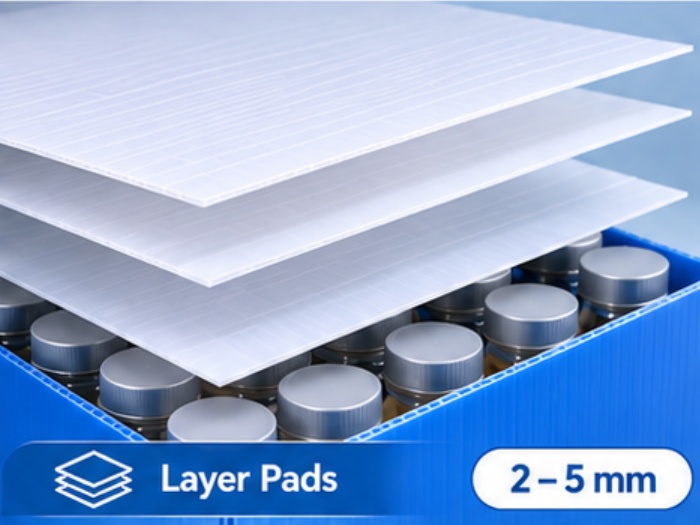 PP layer pads for products protection
Five factors should be evaluated together:
Package dimensions: Larger panels may require more structural support.
Load weight: Consider both total weight and how evenly it is distributed.
Packaging structure: Flat sheets, folding boxes, and internal dividers behave differently under load.
Stacking conditions: Stacking height and pressure from upper layers affect packaging requirements.
Reuse frequency: Repeated loading, unloading, and handling require attention to durability.
Thickness alone cannot determine the load-bearing performance of PP corrugated plastic packaging. Board weight, flute structure, reinforcement, and fabrication also matter.
When requesting a quotation, provide:
| Information | Details |
|---|---|
| Product type | Box, turnover container, divider, or layer pad |
| Dimensions | Length, width, height, or panel size |
| Load weight | Approximate weight of packed products |
| Packaging structure | Flat sheet, folding box, assembled box, or divider layout |
| Stacking conditions | Stacking arrangement and load conditions |
| Reuse frequency | Single-use or repeated circulation |
| Required thickness | Existing or preferred specification |
| Quantity and processing | Order volume, cutting, perforation, printing, or fabrication |
Drawings, samples, or photographs can help the manufacturer evaluate the required specifications more accurately.
Henan Enda New Material Co., Ltd. supplies PP hollow boards in 1.8–15 mm thicknesses, together with customized packaging products including PP hollow boxes, turnover boxes, corrugated dividers, and plastic layer pads.
Available options include customized dimensions and colors, cutting, perforation, UV printing, and fabrication.
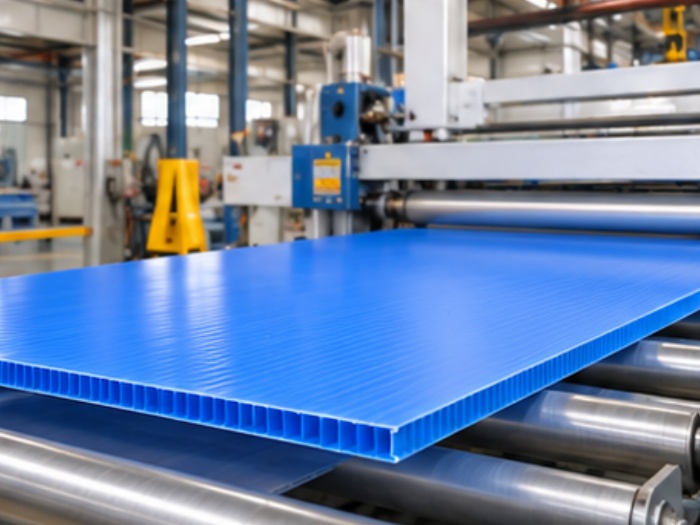 PP corrugated plastic sheets manufacturer
For packaging projects, Enda can discuss board specifications and processing solutions according to product dimensions, load conditions, stacking arrangements, and structural requirements. The 4–5 mm and 8 mm examples above are published application references, not universal specifications for every project.
For packaging development, 3–5 mm is a useful starting reference for general PP hollow boxes, 2–5 mm for dividers, and 2–5 mm for layer pads. Larger warehouse sorting boxes may require thicker boards; Enda has published an 8 mm example for this application.
Choosing the right PP hollow board thickness requires more than comparing millimeter values. The packaging structure, load conditions, and expected reuse all need to be considered together. Henan Enda supplies PP hollow boards in thicknesses from 1.8 mm to 15 mm, with customized dimensions and fabrication options for different packaging applications. Share your packaging design and working requirements to discuss a suitable specification.
It can be a suitable starting point for some reusable boxes. Enda’s published guidance identifies 4–5 mm as commonly used for reusable storage boxes, but the final choice depends on box dimensions, load, and structure.
No. Enda gives 8 mm as an example for warehouse clothing sorting boxes. Smaller or lighter-duty containers may need a different specification.
No. Divider height, compartment dimensions, board weight, and product positioning also affect performance. A thicker board does not automatically solve an unsuitable divider design.
Not necessarily. Layer pads and boxes have different structures and load conditions. Layer-pad supplier listings commonly show 2–5 mm options, but the required thickness depends on the stacking application.
Henan Enda lists PP hollow board thicknesses from 1.8 mm to 15 mm, with customized dimensions, colors, and processing options for packaging products.

Reliable manufacturer of PP hollow board and corrugated plastic products with global reach.
Henan Enda
Copyright © 2019-2026.Henan Enda New Material Co., Ltd

